Ray White conducts around one in four auctions nationally. The real-time buyer data from more than 64,000 campaigns since 2022 offers an unusually clear view of how investor behaviour has responded to the Budget.
The housing measures announced in the federal Budget on 12 May were intended to reduce the number of investors buying established properties. In the weeks immediately following the Budget, the early evidence suggested this was occurring. Investor buying fell and investors accounted for their lowest share of auction buyers recorded this year. More recent data, however, suggests that initial response may be fading.
Ray White conducts around one in four auctions held across Australia, giving us a strong view of who is buying and selling in real time. This analysis draws on more than 64,000 auction campaigns since the beginning of 2022 and identifies buyers and vendors as either investors or owner-occupiers.
The number of investors buying at auction has fallen substantially since the Budget. In the nine complete weeks following 12 May, there were 390 investor buyers, down from 564 over the preceding nine weeks, a decline of 31 per cent. However, the auction market stalled more broadly over the same period. Owner-occupier buyer numbers fell by 24.5 per cent, while total identified buyers declined by 26 per cent. Fewer investors were buying, but there were also far fewer homes changing hands at auction.
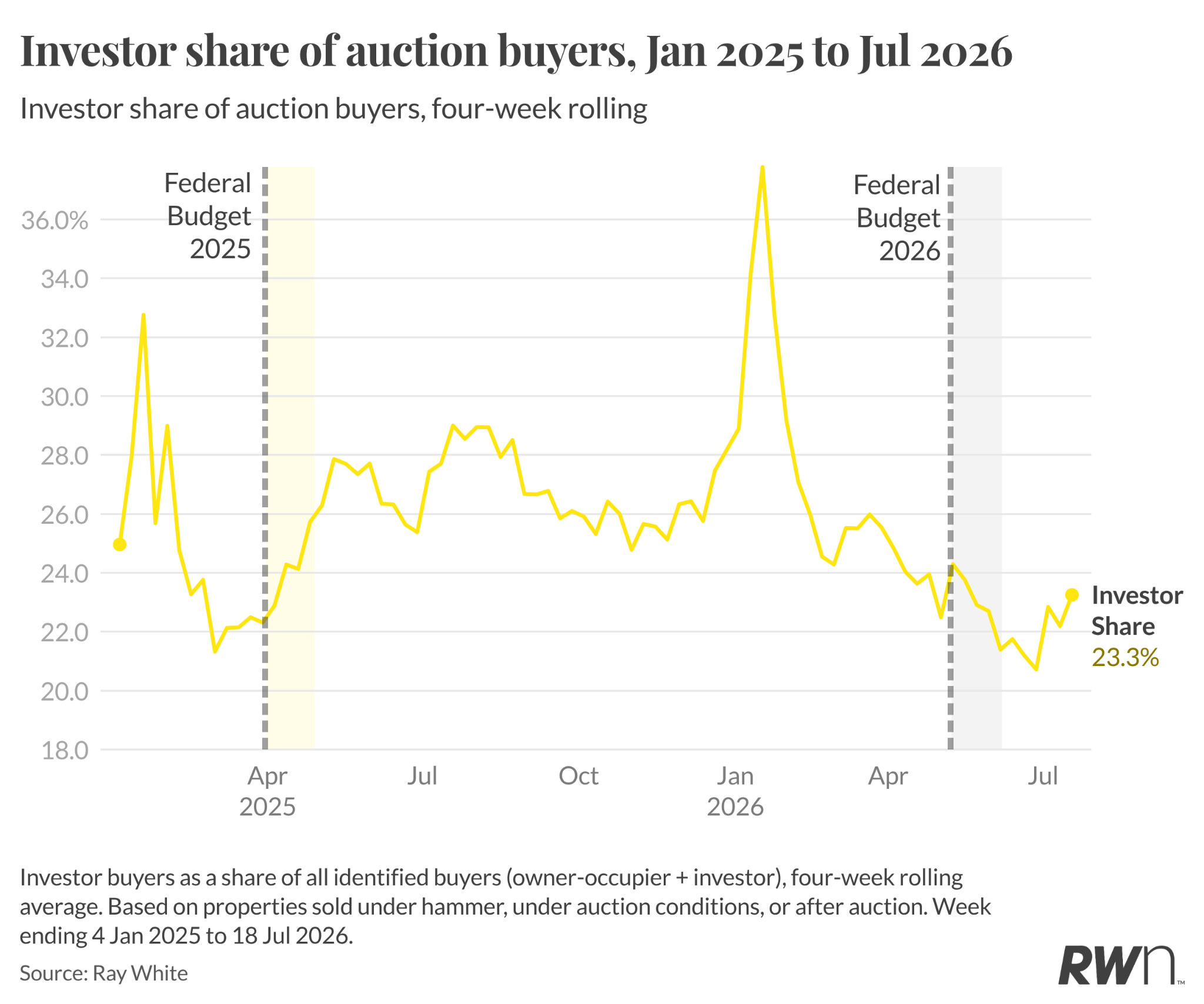
The proportion of buyers who were investors provides a clearer indication of whether their behaviour changed relative to the rest of the market. On a four-week rolling basis, investors accounted for 24.3 per cent of buyers immediately before the Budget. Their share then fell to 20.7 per cent in the four weeks ending 27 June, the lowest four-week investor share recorded in 2026.
Since then, investor participation has begun to recover. By the four weeks ending 18 July, investors accounted for 23.2 per cent of buyers. This remains slightly below the level immediately before the Budget and well below the 29 per cent recorded over the equivalent four weeks last year. Nevertheless, the direction has changed, with investor participation moving back towards its pre-Budget level.
The recovery should not be overstated. There were 166 investor buyers in the latest four weeks, compared with 149 in the four weeks ending 27 June, but still fewer than the 181 recorded in the first four complete weeks after the Budget. Some of the increase in investor share also reflects continued weakness among owner-occupiers rather than a strong rebound in investor demand.
There has been even less change on the selling side. Investor vendor numbers fell by 31.4 per cent after the Budget, broadly matching the decline in investor buyers, while their share of vendors edged down from 30.2 per cent to 28.7 per cent. There were 71 investor buyers for every 100 investor vendors before the Budget and 72 afterwards. There is no evidence of a post-Budget investor sell-off.
The initial fall in investor participation suggests the Budget may have influenced buyer behaviour, at least temporarily. The subsequent recovery makes the longer-term impact less certain. We do not yet know whether investor participation will continue to rise as auction volumes recover, or whether the post-Budget decline will re-emerge.