The federal government has changed the rules on how self-managed superannuation funds can invest in residential property, as part of broader tax legislation passed through the Senate this week.
Under the new rules, SMSFs will no longer be able to use borrowed money to purchase residential property. The change takes effect 45 days after the bill receives royal assent. Existing arrangements are protected, and commercial property borrowing inside SMSFs is unaffected.
For most investors, the immediate answer to “does this affect me?” is no. But it’s worth understanding what changed and what it means in practice.
What is SMSF property borrowing?
When an SMSF buys property using a loan, rather than cash held in the fund, it does so through a structure called a limited recourse borrowing arrangement. The “limited recourse” part means that if the fund defaults, the lender can only claim the specific property used as security. Other assets held in the SMSF are protected.
This structure allowed trustees to purchase investment property using their superannuation balance as a foundation, with borrowing to bridge the gap, similar in concept to a standard mortgage, but inside the superannuation environment. It is this borrowing mechanism, specifically for residential property, that the new legislation removes for future transactions. Borrowing to purchase commercial property inside an SMSF remains available.
Why did this change happen?
Concerns about SMSF borrowing for residential property are not new. The 2014 Murray Financial System Inquiry recommended restricting the practice on financial stability grounds, and the Council of Financial Regulators raised the same issue in both 2019 and 2022. The recommendation sat unacted on for over a decade.
What brought it to a head now was the budget’s broader changes to negative gearing and capital gains tax. With those changes in place, SMSFs were positioned as a remaining avenue for tax-advantaged residential property investment, a gap that was already attracting attention before the legislation passed.
The ban closes that avenue for future transactions.
How much of the market does this affect?
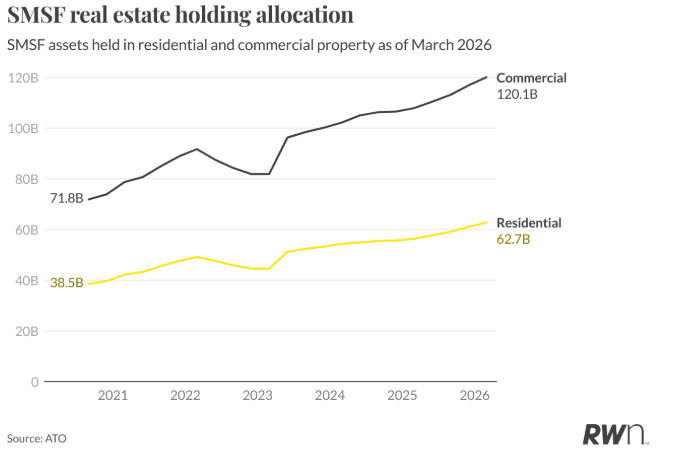
According to the latest ATO data, SMSFs hold $1.06 trillion in total assets. Residential property accounts for $62.7 billion of that, which equals 5.9 per cent. Commercial property holdings, at $120.1 billion, are nearly double the residential figure and are untouched by the legislation.
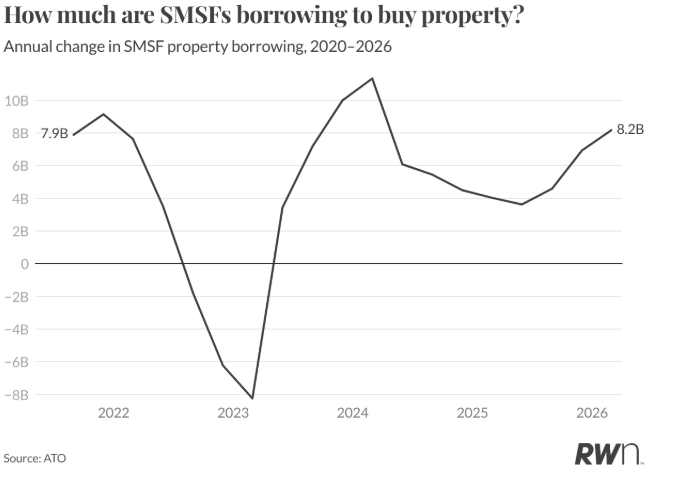
Annual growth in SMSF property borrowing averaged around $6–8 billion in recent years, after contracting briefly in 2023 as interest rates rose. Against $158 billion in new investor lending nationally over the year to March 2026, the residential component of SMSF borrowing growth represents a small portion of the overall market.
What does this mean for existing investors?
If you already hold residential property inside an SMSF, nothing changes. Your existing loan and ownership structure is protected under the legislation.
What the legislation removes is the option to use borrowed money inside an SMSF to purchase new residential property going forward. A 45-day transition period applies from the date of royal assent, allowing any arrangements currently in progress to be finalised before the ban takes effect.