Artificial intelligence is already delivering meaningful productivity gains across large parts of the economy. In industries like finance, healthcare and professional services, it is automating routine tasks, improving decision-making and allowing output to scale without a corresponding increase in labour. Construction, however, has been slower to follow. The nature of the work – physical, site-based and highly variable – makes the application of AI less direct than in more information-driven sectors.
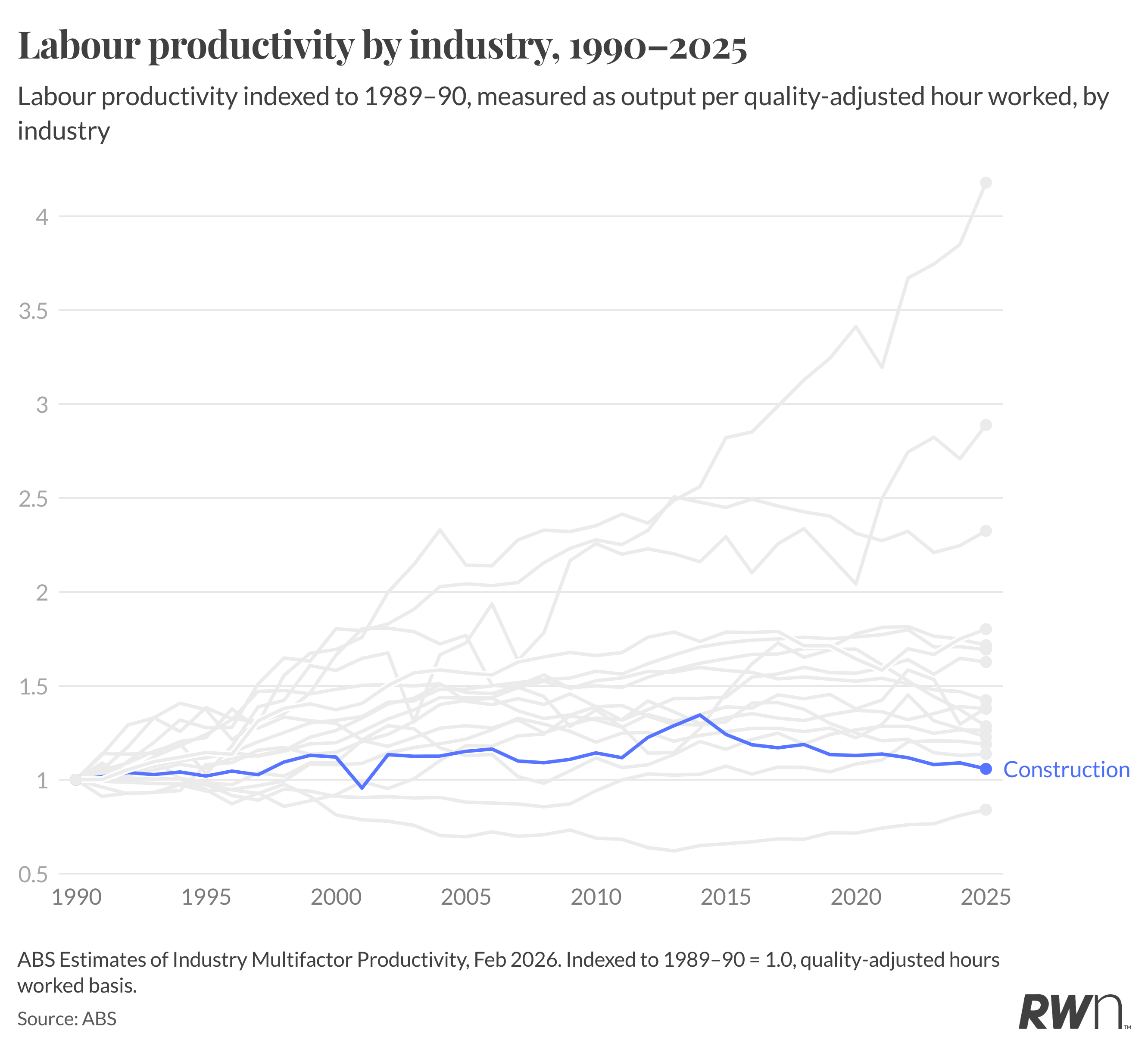
Construction’s productivity problem is not new – it is evident in how little progress has been made over time. On a labour productivity basis, the industry has seen only minimal gains over the past three decades, with output per hour barely increasing since the late 1980s. This stands in sharp contrast to most other sectors. Across the broader economy, productivity has risen substantially over the same period, with particularly strong gains in financial services, manufacturing and other knowledge-based industries. The result is not simply that construction sits at a lower level of productivity, but that it has fallen further behind over time. This reflects the nature of the industry itself: project-based work, fragmented delivery models and constantly changing site conditions make it difficult to embed and scale efficiency improvements in the way other sectors have been able to achieve.
The largest potential productivity gains in construction are still expected to come from robotics and modern methods of construction, such as prefabrication and modular building. By shifting more activity into controlled factory environments, these approaches offer the possibility of standardisation, automation and much higher efficiency. However, they remain some way from being deployed at scale, particularly in Australia, where regulatory, design and industry structures are not yet fully aligned with this model.
While robotics is still some way off being deployed at scale, AI is expected to lift construction productivity in more immediate ways – by reducing downtime between tasks, minimising costly errors, and improving decision-making before and during projects.
Reducing downtime between tasks
A significant share of lost productivity in construction comes not from how work is performed, but from gaps between tasks. Poor coordination between trades, delays in preceding activities and last-minute schedule changes often leave workers idle. AI can help address this by optimising project schedules, identifying likely bottlenecks in advance and dynamically adjusting sequencing as conditions change. The result is a more continuous workflow, where labour and equipment are used more efficiently across the life of a project.
Minimising costly errors
Rework remains one of the largest sources of inefficiency in construction, often arising from design inconsistencies or miscommunication between stakeholders. AI is improving this through tools that can automatically detect clashes and inconsistencies in project plans before construction begins. Combined with on-site monitoring technologies that identify defects early, this reduces the need for costly corrections later in the build process, where disruptions are more expensive and time-consuming.
Improving decision-making
Construction projects involve a high degree of uncertainty, from weather disruptions to supply chain delays and cost fluctuations. AI can improve outcomes by analysing large volumes of historical and real-time data to better predict risks, optimise procurement and refine cost estimates. By enabling more informed decisions earlier – and better adjustments as projects progress – AI helps reduce delays and cost overruns that have traditionally constrained productivity in the sector.
AI is unlikely to solve construction’s productivity problem on its own – but it does address many of the factors that have held the industry back. Rather than transforming how buildings are physically constructed, its impact will be felt in how projects are organised, coordinated and delivered. In an industry where inefficiencies are often embedded in processes rather than effort, even incremental improvements can compound over time. The result is not a sudden step change in productivity, but a gradual narrowing of the gap between construction and the rest of the economy.